
CRYSTAL OPTICS
Precision Optical Components From Birefringent Crystal Materials
Mosaic Optoelectronics develops and manufactures specialized optical components from crystal materials such as quartz and lithium niobate for imaging, polarization, sensing, and other precision optical systems.
CRYSTAL MATERIALS
Optical Behavior Begins With the Material
Crystal materials can provide birefringence, polarization-dependent behavior, and other useful optical properties that are not available from ordinary isotropic optical materials.
Quartz
A birefringent optical crystal used in polarization control, retardation, beam displacement, and specialized imaging components.
Lithium Niobate
A birefringent and electro-optic crystal used in optical modulation, polarization control, sensing, and specialized photonic systems.
Application-Specific Materials
Material selection depends on wavelength, birefringence, optical function, geometry, environment, and the requirements of the complete system.
CRYSTAL ORIENTATION
Orientation Is Part of the Optical Design
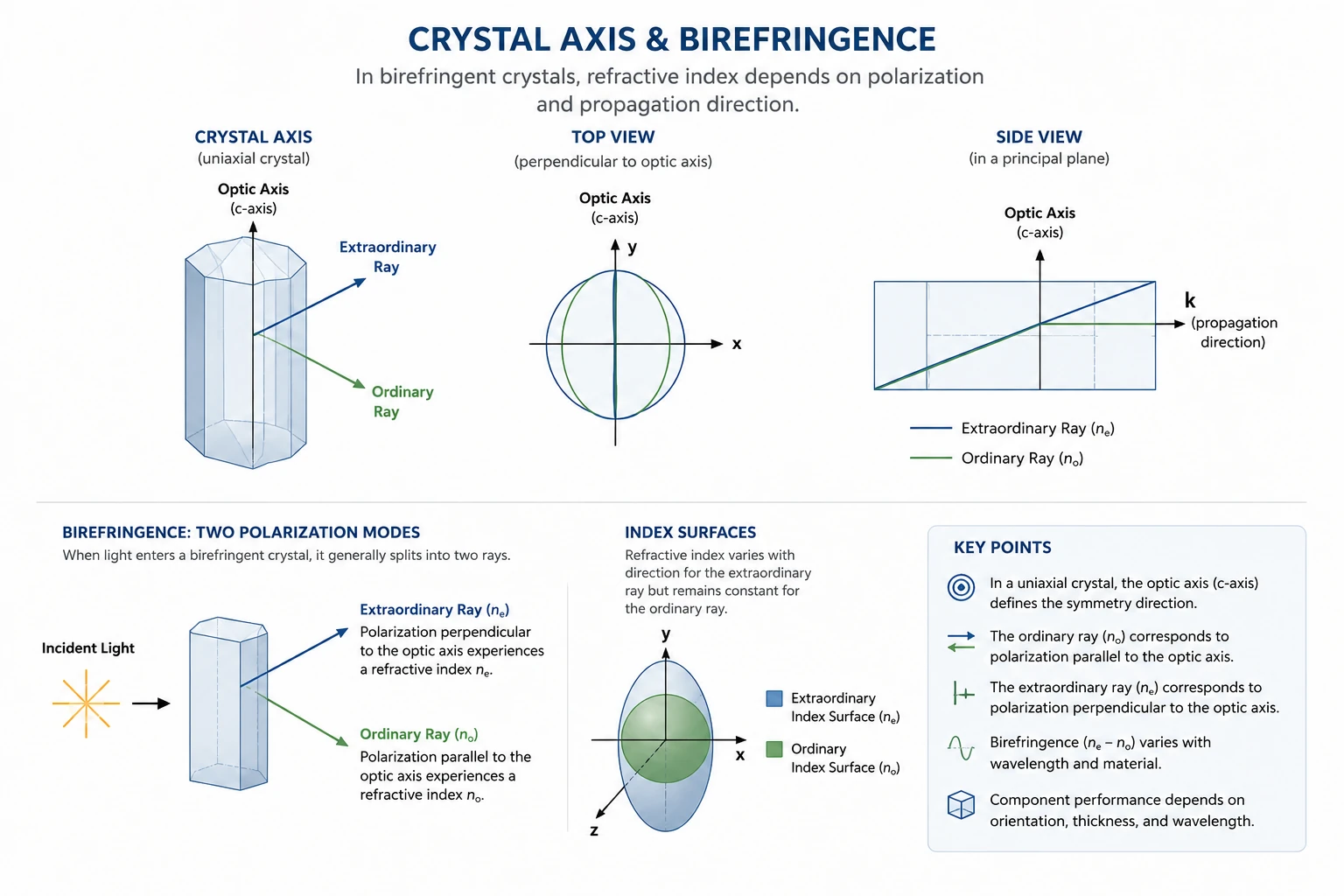
The optical properties of an anisotropic crystal depend on the relationship between light propagation, polarization, and the crystal's optical axes.
A component therefore cannot be defined by external dimensions alone. Crystal orientation, cut direction, thickness, wavelength, and polarization state may all influence its optical behavior.
For birefringent components, controlling that orientation is essential to achieving the intended beam displacement, retardance, or other polarization-dependent effect.
COMPONENT TYPES
Crystal Optics Can Serve Several Optical Functions
The final component geometry and material are selected around the optical function required by the system rather than around a single standard form.
Retardation Elements
Birefringent crystal thickness and orientation can be used to introduce controlled phase differences between polarization components.
Beam-Displacing Elements
Crystal birefringence can produce controlled separation or lateral displacement of optical information.
Polarization Components
Crystal optics can be incorporated into systems that select, transform, or manage polarization state.
Custom Crystal Components
Application-specific geometries can be developed around wavelength, orientation, aperture, thickness, packaging, and optical behavior.
MANUFACTURED AROUND THE REQUIREMENT
Geometry, Orientation, and Optical Finish Work Together
Crystal components often require control of more than simple length, width, and thickness. Optical orientation and surface quality are part of the functional definition of the component.
Geometry
External dimensions, thickness, aperture, edge treatment, and mechanical integration are defined around the intended system.
Crystal Orientation
Optical-axis orientation is considered relative to propagation, polarization, and the desired optical effect.
Optical Surfaces
Surface preparation and polishing influence transmitted wavefront, scattering, interface quality, and the performance of the complete optical element.
PRECISION FABRICATION
Crystal Components Require Careful Processing
Optical crystals can behave differently from conventional glass during cutting, shaping, handling, polishing, and inspection.
Fabrication must account for crystal orientation, material behavior, surface quality, thickness control, wedge, edge condition, and the mechanical requirements of the finished part.
For custom work, the manufacturing approach is considered together with the optical function from the beginning of the project.
MANUFACTURING CONSIDERATIONS
- Material selection
- Crystal-axis orientation
- Component geometry
- Thickness and wedge
- Surface preparation and polishing
- Handling and cleanliness
- Measurement and inspection
MEASUREMENT AND VERIFICATION
Metrology Supports the Manufacturing Process
Precision optical fabrication depends on measurement throughout the process rather than inspection only at the end.
Dimensional inspection, surface evaluation, interferometric measurement, and other appropriate verification methods can be used to support component fabrication and final evaluation.
The exact measurement approach depends on the component, material, geometry, and optical requirement.
PROCESS FEEDBACK
- Dimensional verification
- Thickness and geometry checks
- Surface-quality evaluation
- Optical flatness or transmitted-wavefront evaluation where applicable
- Orientation and assembly verification where required
APPLICATIONS
Crystal Optics in Specialized Imaging and Optical Systems
Birefringent crystals become useful when polarization, beam displacement, phase retardation, or other anisotropic material properties contribute to the required system behavior.
Optical Anti-Aliasing
Birefringent elements can be used to produce controlled image displacement before sensor sampling.
Polarization Control
Crystal components can introduce controlled retardance or other polarization-dependent effects.
Scientific Imaging
Specialized crystal components may be used in instrumentation, sensing, imaging, and research optical systems.
Custom Optical Systems
Application-specific crystals can be incorporated into larger optical assemblies with defined geometry and orientation.
STARTING A CRYSTAL-OPTICS PROJECT
Define the Optical Function Before the Component
Crystal selection and geometry are most useful when they are tied directly to the required optical behavior and the constraints of the complete system.
Existing drawings, optical requirements, sample components, or system information can all provide a useful starting point for evaluating a custom crystal optic.
USEFUL PROJECT INFORMATION
- Desired optical function
- Operating wavelength or spectral range
- Preferred or required crystal material
- Crystal orientation or cut information, if known
- Required external dimensions and clear aperture
- Thickness and wedge requirements
- Surface and optical-performance requirements
- Prototype and anticipated quantity requirements
CUSTOM CRYSTAL OPTICS
Need a Crystal Component for a Specialized Optical System?
Share the optical function, wavelength, material, orientation, geometry, and performance requirements. We can help evaluate the component and manufacturing approach.